News & Updates
How OHOPRS Connects Support to Sustainable Poverty Exit
OHOPRS is designed so that support does not end with temporary assistance. Its operating model connects immediate needs to an adaptive pathway towards recovery, economic inclusion, resilience and sustainable self-reliance.
How OHOPRS Connects Support to Sustainable Poverty Exit
For households experiencing poverty or humanitarian vulnerability, immediate assistance can be essential. Food support, cash assistance, protection and other interventions can help families respond to urgent needs and withstand periods of crisis.
But the longer-term challenge is equally important: what happens after the immediate intervention?
The One Humanitarian One Poverty Response System (OHOPRS) is designed around the principle that support should, wherever possible, connect vulnerable households to a wider pathway towards recovery, resilience, economic inclusion and sustainable self-reliance.
In simple terms, support should lead somewhere.
From immediate need to longer-term progress
Households experience vulnerability differently.
One family may require urgent humanitarian assistance following displacement or disaster. Another may require social protection to stabilise household welfare. Others may need livelihood recovery, access to productive opportunities or interventions that strengthen resilience against future shocks.
A coordinated poverty-response system must therefore be capable of recognising different needs while connecting interventions to longer-term outcomes.
The broader OHOPRS pathway can be understood as:
Humanitarian Support → Social Protection → Livelihood Recovery → Economic Inclusion → Resilience → Self-Reliance
This pathway is not intended to be rigid.
Households may enter at different points, move through different forms of support or return to earlier stages when circumstances change. What matters is that interventions are connected to an understanding of the household's needs, progress and longer-term prospects.
Humanitarian support: responding when needs are urgent
Humanitarian intervention addresses immediate vulnerability.
During crises, the priority may be protecting life, preserving dignity and helping households meet essential needs.
Such assistance remains a critical part of the national response. OHOPRS does not replace humanitarian support. Instead, the architecture seeks to strengthen the connections between immediate response and the wider systems that can support recovery and resilience.
Social protection: helping households stabilise
For vulnerable households, moving beyond crisis often requires a period of greater stability.
Social protection can provide an important bridge by helping households manage vulnerability, protect basic welfare and reduce exposure to shocks.
Within the wider OHOPRS architecture, this support should not exist in isolation. Where appropriate, it can connect with other interventions capable of strengthening a household's productive capacity and future prospects.
Livelihood recovery: restoring productive capacity
For many households, sustainable progress depends on the ability to earn an income and rebuild productive livelihoods.
Livelihood recovery therefore represents an important part of the pathway.
Depending on household circumstances and applicable programmes, this may involve support that enables people to rebuild economic activity, strengthen skills or reconnect with productive opportunities.
The objective is not simply to provide assistance indefinitely, but to create conditions under which households can increasingly participate in their own economic recovery.
Economic inclusion: connecting people to opportunity
Moving from vulnerability towards prosperity requires more than temporary income support.
Economic inclusion is about strengthening the connection between vulnerable households and the opportunities, services and productive systems that can help improve their economic position.
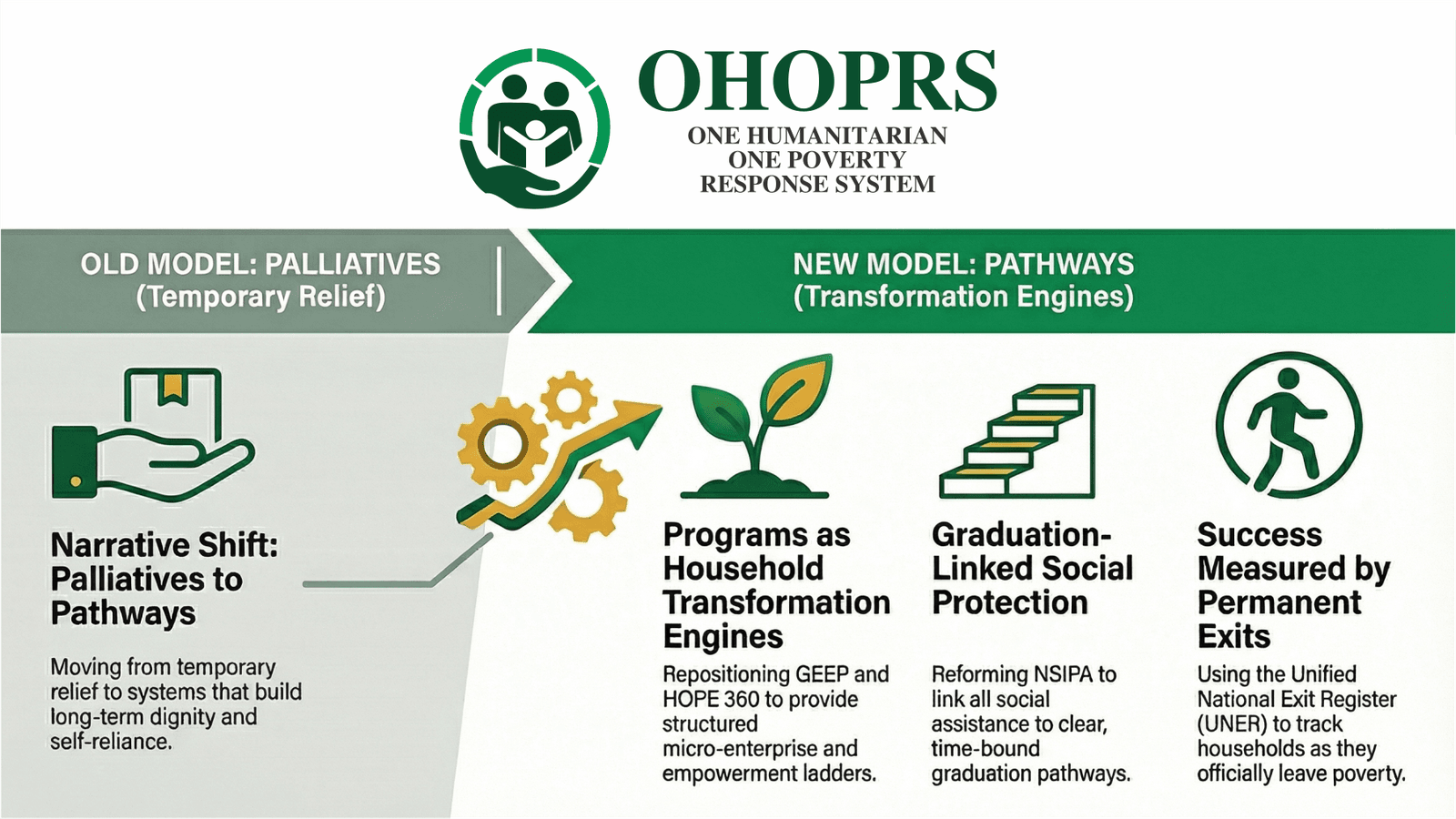
Within OHOPRS, this reinforces the transition from palliatives to pathways: from responding primarily to immediate hardship towards creating routes through which people can build greater economic security.
Resilience: strengthening the ability to withstand shocks
Progress can be lost when households remain highly vulnerable to economic, environmental, humanitarian or other shocks.
Resilience therefore matters.
A household that has begun recovering economically should ideally become better able to withstand future disruptions without immediately falling back into severe vulnerability.
This is one reason OHOPRS connects humanitarian response, social protection and poverty reduction rather than treating them as completely separate policy challenges.
Self-reliance and sustainable poverty exit
The longer-term direction is greater dignity, resilience and self-reliance.
Sustainable poverty exit should not be understood simply as the moment assistance stops. The more meaningful question is whether a household has strengthened its capacity to sustain progress and withstand future vulnerability.
That is why the OHOPRS approach places emphasis on pathways and outcomes.
The ambition is to create a system capable of asking not only:
What support was provided?
but also:
What changed for the household?
Has vulnerability reduced?
Has resilience improved?
Is the household progressing towards greater economic independence?
Tracking progress, not simply expenditure
This approach also changes the way success is measured.
Government programmes understandably track activities and resources. But a results-oriented system must go further by connecting those activities to their consequences.
The OHOPRS results logic follows the progression:
Activity → Output → Outcome → Impact
This means looking beyond what was delivered to consider who was reached, what changed and whether interventions are contributing to meaningful longer-term progress.
Monitoring and evidence can then feed back into planning, targeting and programme decisions.
National architecture, local realities
Although OHOPRS provides a national architecture, poverty is experienced locally.
Households live in communities. Their circumstances differ. Economic opportunities vary between locations, and vulnerability can be shaped by factors ranging from conflict and displacement to livelihoods and access to services.
This makes State and Local Government participation particularly important.
National standards and coordination need to connect with frontline delivery, while evidence and experience from communities need to inform decisions higher within the system.
The relationship must therefore work in both directions.
Putting dignity at the end of the pathway
Ultimately, the pathway from humanitarian assistance to sustainable poverty exit is about more than programme administration.
It is about people.
The objective is to ensure that public support responds to vulnerability while creating stronger connections to recovery, opportunity and resilience.
OHOPRS seeks to provide the architecture through which those connections can become more systematic, accountable and focused on outcomes.
Because the ultimate measure of a poverty-response system should not simply be how much support it distributes, but whether people are increasingly able to build secure, productive and dignified lives.